Phosphorus nutrition and cycling
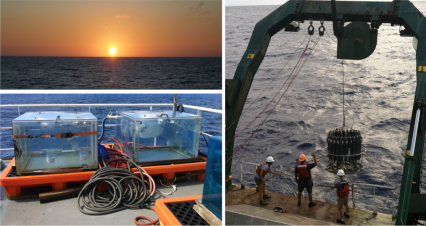
Phosphorus is a vital nutrient for life, but over vast regions of the surface ocean it is in low or limiting supply. One way that phytoplankton cope with P scarcity is to produce enzymes that can digest a wide diversity of P sources, including P-esters (P-O-C bonds), phosphonates (P-C), and polyphosphates (P-O-C). The bioavailability of specific P compounds varies depending on microbial species, and the utilization of certain P sources has been linked to globally significant biogeochemical processes, such as the aerobic production of methane (methylphosphonate) and the formation of calcium phosphate minerals (polyphosphate). However, the mechanisms and comparative magnitude of compound-specific P transformations, and their relative contributions to community-level P demand, productivity, and structure are not completely understood. We aim to fill these knowledge gaps by tracking the fate of specific forms of P in the marine environment and model cultures across gradients in P availability. Results from this work will provide a more robust understanding of the enzymatic basis of compound-specific P transformations and create new knowledge on the relative contribution of these P sources to marine microbial nutrition, community structure, primary productivity, and thus global carbon cycling and climate.
Students: Alisia Holland
Collaborator: Solange Duhamel (Lamont-Doherty Earth Observatory)
Funding: NSF OCE-1736967
Ecophysiology of Superoxide
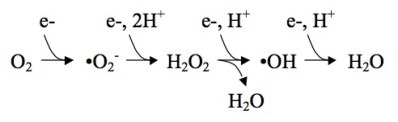
Superoxide is a reactive oxygen species (ROS) formed by the addition of a single electron to molecular oxygen. In the environment, superoxide and subsequent ROS shape the biogeochemical transformations of carbon, as well as nutrient and toxic metals. Recent findings indicate that biological production of extracellular superoxide is more widespread that previously recognized and that these biological ROS sources can contribute substantially to natural fluxes in aquatic systems. However, the ecophysiological purpose of extracellular superoxide production is enigmatic. Using a combination of high-sensitivity superoxide measurements and cellular morphology and vitality assays, we are currently investigating the ecophysiology of extracellular superoxide production in a variety of representative marine phytoplankton species and mixed natural communities. Results from this work will help reveal mechanisms of redox homeostasis and baselines of marine ecosystem health and function.
Students: Sydney Plummer
Collaborators: Colleen Hansel (WHOI), Catharina Alves-de-Souza (UNC Wilmington), Carmelo Tomas (UNC Wilmington)
Funding: NSF Graduate Research Fellowship to S. Plummer
Polyphosphate and apatite formation
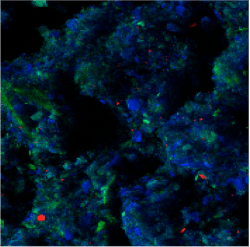
Phosphorus is a vital nutrient required by all forms of life. It is an essential ingredient in DNA, energy-carrying compounds like ATP, and structural molecules such as phospholipids. In the oceans, the availability of nutritious phosphorus forms, such as dissolved phosphate, controls long-term marine biological activity, photosynthetic uptake of atmospheric carbon dioxide, and therefore climate. A key process that eliminates nutritious phosphorus from the oceans is the incorporation of dissolved phosphate into inedible calcium phosphate minerals known as apatites, which are also the main constituent of biominerals like teeth and bones. Apatites are found in marine sediments worldwide as microscopic mineral grains. However, the direct formation of apatite from the phosphate dissolved in seawater is too slow to explain the amounts of apatite that are present. Thus, the formation of marine apatite remains mysterious. Classic ideas proposed that sedimentary apatites come directly from fish bones, but it has become clear that marine apatite formation may depend on a chemical known as polyphosphate (Diaz et al. 2008, Science).
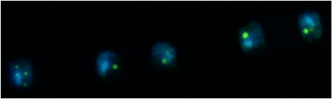
Polyphosphate is a simple chain of phosphate ions. It is synthesized by all forms of life, and it has a critical role in many cellular processes, such as apatite biomineralization. We are currently investigating how cell-free polyphosphates may promote apatite formation in seawater and marine sediments.
Students: Alisia Holland
Collaborator: Yuanzhi Tang (Georgia Tech)
Funding: NSF OCE-1559124
Phytoplankton exoenzymes
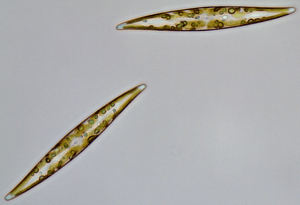
Marine phytoplankton are vital members of the Earth system. They form the base of the marine food web, take up the greenhouse gas carbon dioxide, and generate half the world’s oxygen supply. The biogeochemistry of phytoplankton is often mediated by enzymes, including exoenzymes that are attached to the cell surface or released to the environment. Using proteomic techniques, we are currently characterizing exoenzyme functional diversity among model phytoplankton cultures in order to identify candidate enzymes that are involved in the phosphorus physiology and redox homeostasis of these critical microorganisms. This research helps illuminate the molecular-level stress responses of phytoplankton to a variety of biogeochemical challenges, which has implications for the health and vitality of marine ecosystems and the role of marine microorganisms in Earth system functioning.
Students: Sydney Plummer, Alisia Holland
Collaborators: Colleen Hansel (Woods Hole Oceanographic Institution) and Peter Andeer (Lawrence Berkeley National Lab)
Funding: University of Georgia Research Foundation
 The Diaz Lab